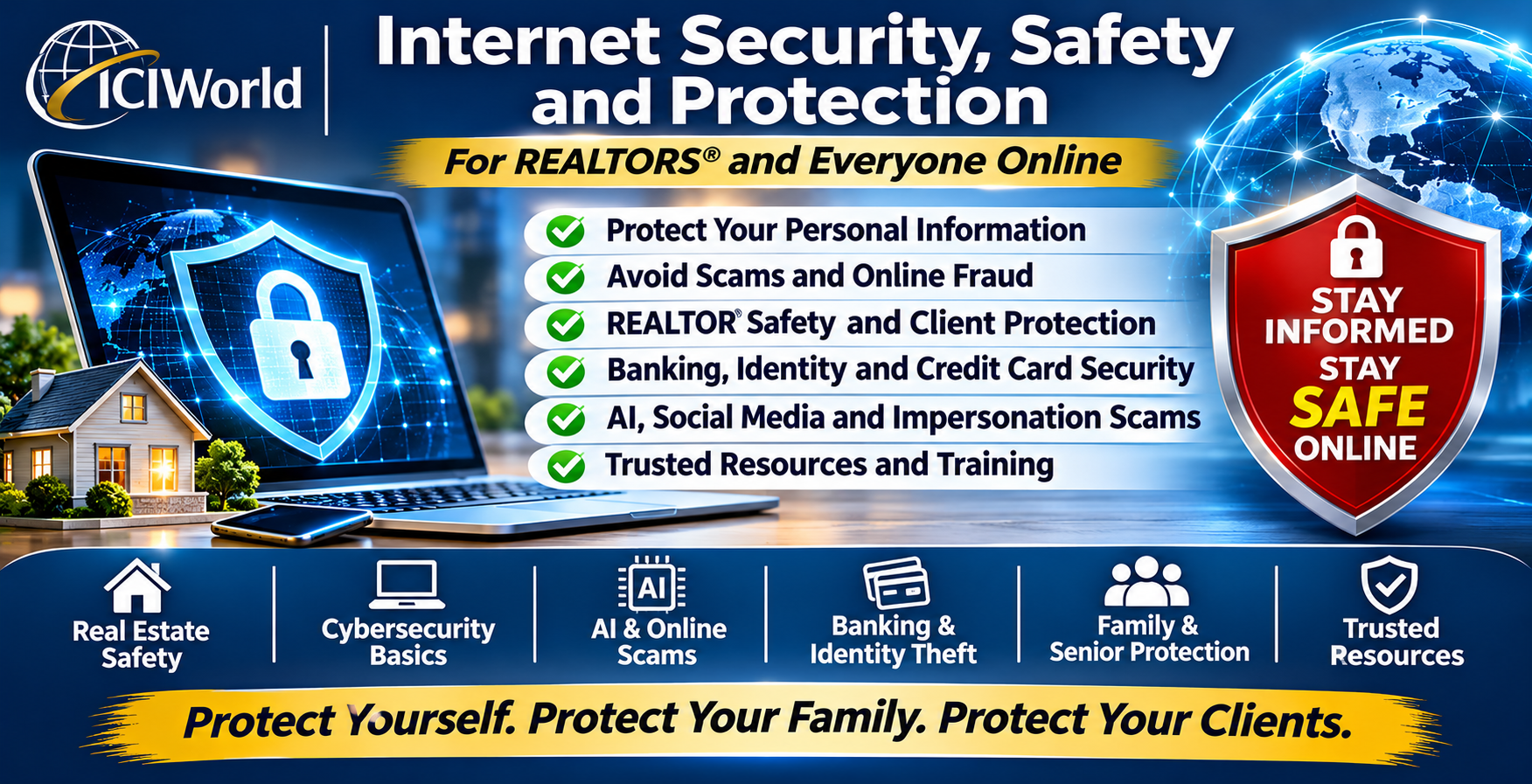
Essential Reading for Everyone Who Uses the Internet
One Page. A Wealth of Security Knowledge. Protection for Everyone.
Explore practical Internet security information, real-life fraud investigations, educational videos and trusted resources to help protect REALTORS®, real estate brokers and salespeople, families, friends, clients, customers and everyone who uses the Internet.
A Self-Guided Internet Safety Course
This page contains enough educational resources for a full day of learning and more. Explore the links, watch the investigations and learn to recognize warning signs before becoming a victim.
Learn It. Use It. Share It. Help Protect Others.
You do not have to study everything in one sitting. Bookmark this page and return whenever you have time.
Please Share This Free Security Resource
One piece of information could help someone avoid losing their savings, their identity or their personal security.
An Hour Spent Learning About Scams Today Could Prevent a Serious Loss Tomorrow.
Please take the time to explore these resources, watch the real-life investigations and share what you learn with your family, friends, colleagues and clients.
Learn How Scammers Operate — Before You Become a Victim
CTV News Investigations and Reports on Internet Scams
We strongly encourage everyone to spend time exploring these reports.
CTV News covers real examples of online fraud, identity theft, romance scams, impersonation, financial scams, real estate fraud and other deceptive practices.
By learning how scams work, the warning signs people missed and how victims were targeted, you may become better prepared to recognize similar situations before they cause serious harm.
The More Scams You Recognize, the Better Prepared You Can Be to Avoid Them.
▶ EXPLORE CTV INTERNET SCAM REPORTS
Opens CTV News search results for Internet scams.
Protect Yourself. Protect Your Family. Protect Your Clients.
Bookmark this resource and return regularly to learn about different fraud tactics. Reporting may change over time; verify important advice using official sources.
⚠️ Protect Yourself, Your Family, Your Clients, and Your Money Online
The Most Important Page You May Ever Read on the Internet
Every day, thousands of people lose money, personal information, passwords, investments, real estate deposits, and business opportunities because they are unaware of the latest scams, frauds, phishing attacks, identity theft schemes, and online deception techniques.
This page has been assembled as a public service to help REALTORS®, real estate professionals, investors, business owners, consumers, families, and the public recognize dangers before they become victims.
Just one tip on this page could save you thousands of dollars, months of stress, or even protect your life savings.
Contact a member to help you network your information.
The Internet Has the Good, the Bad and the Ugly
By understanding the bad and the ugly, you can better recognize warning signs and avoid problems.
The Internet provides extraordinary opportunities for communication, education and business — but it is also used by scammers, fraudsters and criminals. Education, awareness and verification are among your best protections.
🎓 Safety • Security • Education
One of the best ways to protect yourself, your family, your clients, customers and colleagues is to learn how scams work. Real examples can help people recognize suspicious situations before money, personal information or confidential information is lost.
🏠 Real Estate Scam Videos from CTV News
Real estate scams can affect buyers, sellers, tenants, landlords, investors and real estate professionals. CTV News has reported on numerous real estate-related scams and frauds.
📺 Learn From W5 Investigations
The CTV W5 program has provided in-depth investigative journalism exposing scams, fraud, consumer risks and many other serious issues.
These reports can be valuable educational tools because they show how real situations develop, the warning signs people may have missed and the consequences that can follow.
🏠 Real Estate Scam Videos on Our YouTube Curated Security and Protection Playlist.
Real estate scams can affect buyers, sellers, tenants, landlords, investors and real estate professionals- basically everyone who is on the Internet.
👨👩👧👦 Share Security Education With Others
Where appropriate, we encourage you to share this information with your family, friends, colleagues, clients and acquaintances.
Consider watching relevant W5 and other reputable investigative reports together as a family. Seeing actual examples can make scam and fraud awareness much easier to understand than simply reading a warning.
Security, fraud awareness and responsible Internet use are also valuable educational subjects for young people. Where appropriate, programs such as W5 investigations can provide useful material for discussion in schools, homes and community organizations.
“`
STOP • VERIFY • CONFIRM
Before you click a link, send money, provide personal information, change a password or respond to an urgent request — verify it independently.
Fraudsters can impersonate companies, financial institutions, government agencies, real estate professionals, friends and even family members. Artificial Intelligence can make fake emails, websites, documents, photographs, videos and voices increasingly convincing.
“`
🔐 A Golden Rule of Internet Security
Do not automatically trust a link, message, telephone call, email or social media communication simply because it appears legitimate.
✔ Verify telephone numbers independently before calling.
✔ Confirm unusual requests directly with the person or organization involved.
✔ Verify payment instructions before sending or transferring money.
✔ Never allow urgency or pressure to prevent you from checking first.
✔ If you are uncertain, do not act until you have independently verified the situation.
“`
🏢 Especially Important in Real Estate
Real estate transactions can involve large sums of money, deposits, banking information, contracts, identification and confidential personal information.
Buyers, sellers, investors, landlords, tenants, brokers and salespeople should independently verify important instructions — particularly requests involving money transfers, deposits, banking information or sudden changes to payment instructions.
“`
“`
🌎 Please Use and Share This Security Resource
The purpose of the ICIWorld® Security, Safety and Protection page is education. We encourage people to learn, verify information, recognize warning signs and share useful security information with others.
Education today may prevent a serious problem tomorrow.
⚠️ One Click Can Change Everything
One mistaken click on a fraudulent email, text message, social media post, QR code, or fake website can result in:
- Identity Theft
- Bank Account Fraud
- Credit Card Fraud
- Real Estate Deposit Fraud
- Wire Transfer Fraud
- Business Email Compromise
- Loss of Confidential Information
- Computer Malware and Ransomware
- Social Media Account Hijacking
- Financial Losses and Emotional Stress
The good news? “Learning how scams operate can greatly improve your ability to recognize warning signs. However, even knowledgeable people can be deceived, so always verify suspicious requests independently.”
🔐 The Golden Rule of Internet Security
Never click a link in an email, text message, or social media message that asks you to:
- Log In
- Change Your Password
- Verify Your Account
- Confirm Banking Information
- Transfer Money
- Update Payment Details
- Provide Personal Information
Instead:
- ✔ Open your browser and go directly to the company’s website.
- ✔ Call the company using a trusted phone number.
- ✔ Verify requests independently.
- ✔ Ask a trusted professional if you are unsure.
When in doubt, DON’T CLICK.
🤖 AI Has Changed the Security Landscape
Artificial Intelligence can now create:
- Fake Emails
- Fake Websites
- Fake Documents
- Fake Photos
- Fake Videos
- Voice Cloning
- Impersonation Scams
If you receive an urgent request involving money, passwords, confidential information, banking details, cryptocurrency, investments, or account access:
STOP • VERIFY • CONFIRM
Always contact the person or company directly using a trusted phone number before taking action.
🛡️ An Important Message From ICIWorld
ICIWorld has been helping real estate professionals connect with networking opportunities online since 1994.
We encourage all members, website visitors, clients, customers, family members, and friends to remain vigilant online.
If you ever receive a suspicious email, message, or request appearing to come from ICIWorld, verify it independently before taking any action.
Online security is everyone’s responsibility.
Knowledge Is Your Best Antivirus
The purpose of this page is not to create fear.
The purpose is to create awareness.
The more informed you are, the safer you, your family, your clients, your customers, and your business will be.
Please bookmark this page, share it with others, and revisit it regularly as new threats emerge.
Use this page for your online training. Pass it on to others.
Internet Security & Safety Training Resource Centre
Real Estate Safety • Fraud Prevention • Cybersecurity • Family Protection
Continue your education with practical advice, professional resources, government information and investigative reports.
Protect Yourself. Protect Your Family. Protect Your Clients.
1. REALTOR® Safety and Real Estate Fraud Prevention
Real estate professionals may meet unfamiliar people, enter vacant buildings, handle confidential information and participate in transactions involving large sums of money.
For REALTORS®: Verify identities using approved procedures, follow brokerage safety policies, tell colleagues where you are going, and take precautions when meeting unfamiliar prospects.
For consumers: Licensed professionals may request identification and use verification procedures to help protect everyone involved in a transaction.
CREA — Practical REALTOR® Safety Tips →
National Association of REALTORS® Safety Resources →
56 Safety Tips for REALTORS® →
Real Estate Council of Ontario — Consumer Protection →
Use identification and compliance services according to current laws, brokerage procedures and applicable privacy requirements.
2. Internet Security — Seven Essentials Everyone Should Know
1. Use unique, strong passwords. Use long passwords or passphrases for each account. A reputable password manager can help.
2. Enable multifactor authentication. Prefer stronger methods such as passkeys or authenticator applications when available.
3. Beware of phishing. Fraudulent emails, calls, texts and websites can look genuine.
4. Keep devices updated. Install security updates for computers, phones, browsers and applications.
5. Use appropriate security protection. Maintain reputable security tools and backups.
6. Be careful on public Wi-Fi. Use trusted connections for sensitive activities, verify the network and avoid sharing sensitive information unnecessarily.
7. Protect your personal information. Limit what you reveal publicly and carefully review account privacy settings.
National Cybersecurity Alliance — Online Safety and Privacy →
CISA — Cybersecurity and Infrastructure Security Agency →
Password testing tip: Never enter your actual password into an unfamiliar password-strength website. Use a fictional example for demonstrations, and use your password manager’s built-in security features to review real passwords.
3. AI, Social Media, Romance and Family Impersonation Scams
Modern fraudsters may create convincing photographs, documents, voices, videos, identities and websites using Artificial Intelligence.
Common warning signs include:
✔ Unexpected urgent requests for money
✔ Someone claiming to be a relative in an emergency
✔ Online relationships involving repeated requests for financial help
✔ Requests to purchase gift cards or transfer cryptocurrency
✔ Investment opportunities promising unusually high returns
✔ Attempts to obtain passwords, security codes or banking details
✔ Pressure to act immediately or keep a situation secret
A Family Safety Practice
Consider establishing a private family verification phrase. If you receive a suspicious emergency call, hang up and contact your relative using a trusted number. A familiar voice, video call or displayed telephone number alone is not proof of identity.
For online relationships: Never send money to someone simply because you have formed an online connection. Be especially careful when someone refuses independent verification, requests secrecy or claims an emergency.
For grandparents and older adults: Discuss common impersonation scams with trusted family members before an emergency call occurs.
4. Banking, Credit Cards and Identity Theft Protection
Banks and payment companies are frequently impersonated through fraudulent messages, websites and telephone calls.
Never assume that a message is authentic because it displays a familiar bank name or telephone number.
If you receive an unexpected request to log in, confirm banking information, transfer funds or change a password, use your bank’s official application, a saved trusted bookmark or the telephone number printed on your bank card.
Fraudulent websites can also appear in internet search advertisements. Check that you have reached the correct official website before entering account information.
Especially Important for Real Estate Transactions
Before sending deposits, closing funds or other large payments, independently verify the recipient and banking instructions with the appropriate professional using a previously established trusted contact method. Treat sudden changes in payment instructions as a serious warning sign.
Important ICIWorld Security Notice
Do not trust unexpected emails claiming to be from ICIWorld and asking you to change your password through an unfamiliar link.
ICIWorld previously warned members about fraudulent password-change emails, including an incident reported on July 3, 2025.
When a message seems suspicious, do not use the link in the message. Instead, open ICIWorld through your trusted bookmark or type the known website address yourself.
If you are unsure whether a communication is genuine, contact ICIWorld through its established contact details.
ICIWorld.com — 416-214-4875
Never disclose your passwords, multifactor authentication codes or confidential financial details to someone claiming to provide support.
5. What to Do If You Have Already Been Scammed
Act promptly. Depending on what happened:
1. Contact your bank, card issuer or financial institution immediately if money or payment information is involved. Ask about fraud controls and possible recovery options.
2. Change compromised passwords using a trusted device and official website. Secure the associated email account and enable multifactor authentication.
3. Preserve evidence, including screenshots, messages, transaction records, telephone numbers and dates.
4. Report the incident to the appropriate police or fraud-reporting authority.
5. Warn relevant contacts if your email, social media or messaging account may have been compromised.
6. If a device may be infected, seek qualified technical assistance before using it for sensitive transactions.
7. Beware of recovery scams. Fraudsters sometimes contact previous victims claiming they can recover lost money for an advance payment.
If someone is in immediate physical danger, contact local emergency services.
6. Government and Consumer Protection Resources
Government agencies and consumer organizations provide information on identifying scams, protecting personal information and reporting suspected fraud.
Government Resources
Canada’s Anti-Spam Legislation Information →
U.S. Cybersecurity and Infrastructure Security Agency →
Consumer Organizations
Fraud.org — National Consumers League →
Better Business Bureau Scam Tracker →
Canada411 — Telephone Directory →
Telephone directories and caller ID information are not reliable proof of identity. Verify sensitive requests independently.
7. Computer Security and Technical Assistance
Maintaining updated security software, operating systems and reliable backups helps reduce risk. No software product can guarantee complete protection.
For further information, here are some established security software providers:
For technical assistance, consider a trusted local professional or an established service provider such as Best Buy Geek Squad. Always contact providers through independently verified channels, not unexpected calls or pop-up warnings.
8. Learn From Investigative Reports and Real Examples
Actual investigative reports can help people recognize fraud tactics and understand the consequences of scams.
CBC Marketplace
Explore investigations involving fraudulent call centres, deceptive business practices and consumer protection issues.
CTV News and W5
CTV’s investigative reporting includes coverage of romance scams, grandparent scams, identity theft and real estate fraud.
Additional YouTube Learning
Look for educational videos about phishing, ransomware, impersonation, online rental scams and property title fraud. Investigative programs and educational videos are useful starting points, but independently verify important claims.
REAL ESTATE TITLE FRAUD VIDEOS →
JAMES VEITCH — SPAM EMAIL TALK →
Some reports originally collected on this page date from 2016–2023. They remain useful historical examples, but their dates, statistics and specific recommendations may no longer be current.
The Five-Second Safety Habit
STOP • THINK • VERIFY • CONFIRM • THEN ACT
Five seconds of caution may prevent a financial loss or serious personal problem.
Never let a scammer’s urgency become your emergency.
Share This Page With Everyone You Care About
Family, friends, REALTORS®, clients, customers, business owners, seniors, young people and anyone using the Internet can benefit from understanding online risks.
Security Resources, Education, Advice From Major Corporations
Please use this page for your own safety education and share it with others.
Knowledge Today May Prevent a Serious Problem Tomorrow.
Information and Safety Disclaimer: This page is provided for general education and public awareness. Links to third-party organizations are offered as additional resources and do not constitute an endorsement of every statement, product or service. Security threats, scams and reporting procedures change over time. Always verify current information with official sources and qualified professionals.